


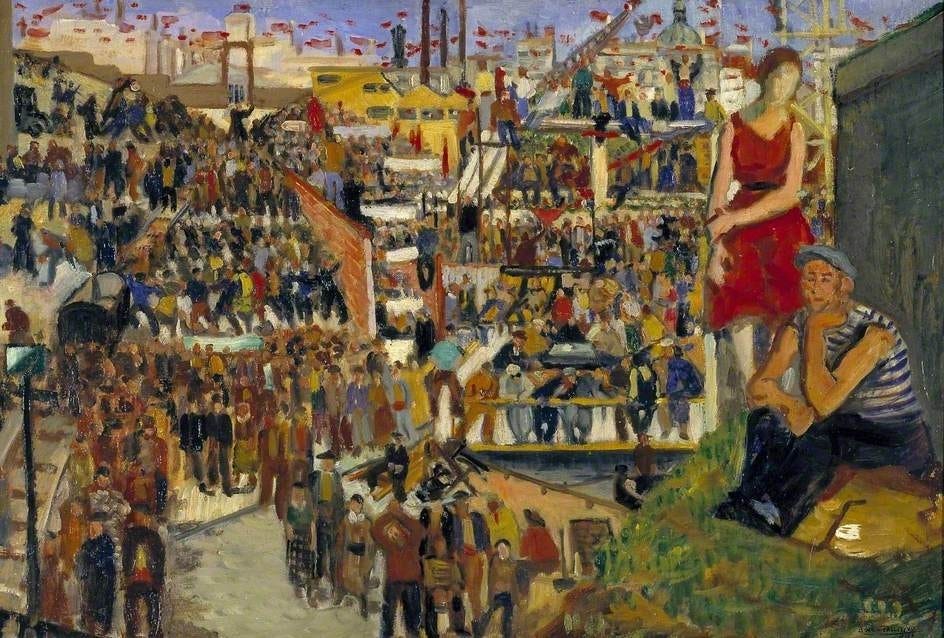
Les Grèves de juin 1936 by Boris Taslitzky (1936)
As the Draghi report sputters in implementation and the West debates data centre moratoriums, one may ask: how do otherwise powerful and capable nations make decisions that amount to self-sabotage? Or, as Julia put it in a recent piece, ‘Do they WANT to be poor?’
Nations are complex systems of interacting institutions, incentives, policies, and so on. This means no decision can be judged in isolation: political compromises reverberate with second-order effects that nobody predicted. Some are more consequential than others, but each alters, however slightly, the constraints under which future decisions are made. Decline is the resulting sediment that accumulates and compounds until the boat sinks.
This matters because, surprisingly, few think about policy this way. When we talk to policymakers, they often ask for ‘AI policy’ and grow frustrated when the conversation turns to planning reform or labour law. They want clean solutions that do not upset important stakeholders or compete with other priorities.
Unfortunately, the constraints that will decide how nations come out of this inflection point have little to do with AI policy strictly defined. This makes reform much harder. But to understand how we got here, and how we get out, we will need to look seemingly unrelated and unglamorous policies.
To make the case for this way of thinking, we want to examine one of the most consequential moments in modern history: the six weeks in 1940 in which France – one of the world’s great powers – was humiliated by a neighbour it had beaten twenty years earlier. And a law, passed four years earlier for understandable reasons, that had nothing to do with the war but did more than anything else to decide the battle.
Why did France fall?
France did not lose the Battle of France because it was poor. In 1939, Britain and France out-produced Germany by a quarter within the borders Hitler had inherited. Even with Austria and the Czechs, which were annexed over the previous year, the Reich’s economy was a tenth smaller. Behind the Allies stood the Dominions and the two largest colonial empires in the world, which between them controlled a third of the world’s land area.1 At the start of the conflict, the Allies looked pretty good.
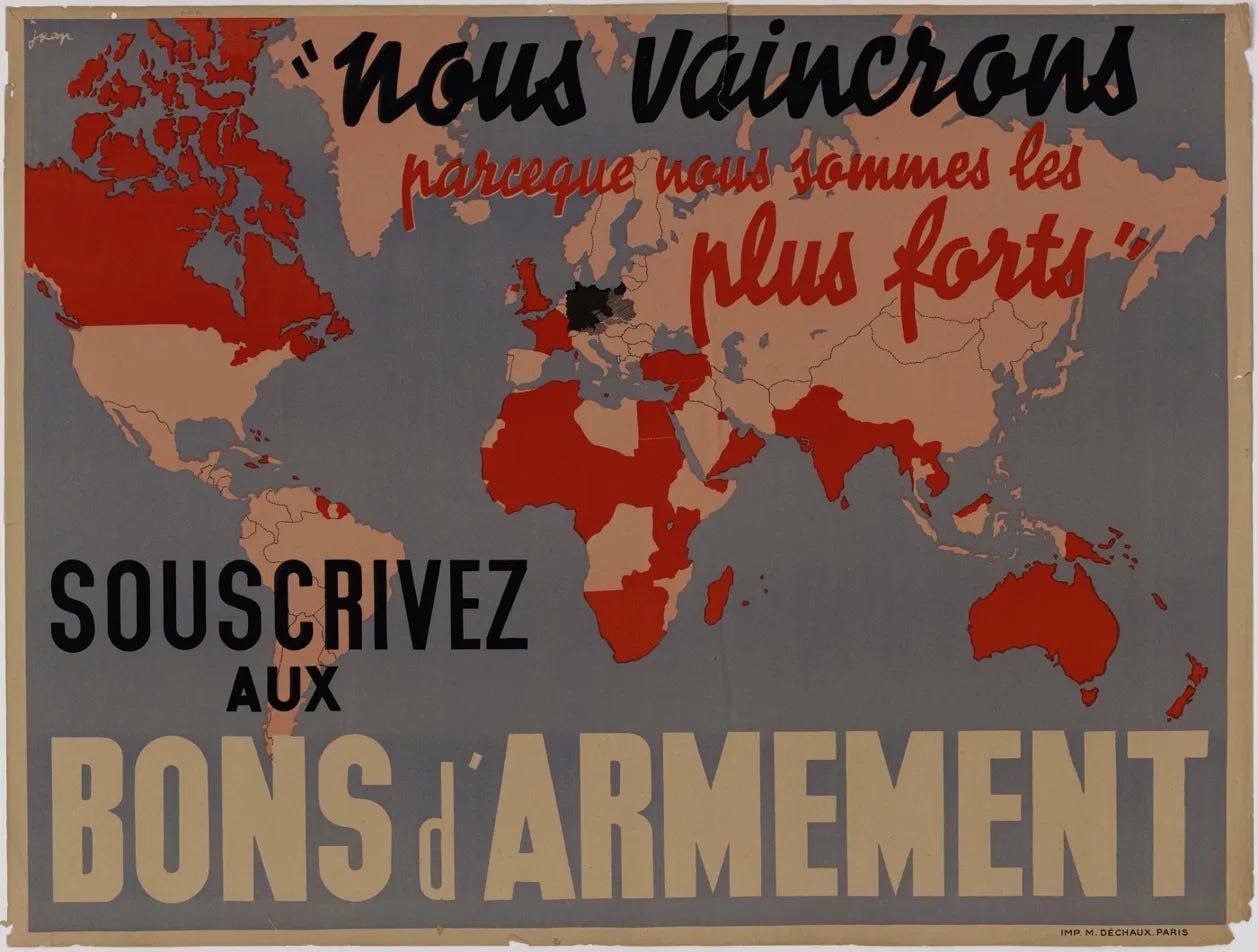
An advertisement for French war bonds (1939)
Notwithstanding narratives of appeasement and pacifism, that money was not sitting idle. Over the six years from Hitler’s accession to the invasion of Poland, Germany outspent the countries that would fight it in 1940 by less than fifteen per cent.2 By the turn of 1940, the Allies were spending about thirty per cent more than Germany each year.3 The German rearmament that so alarmed London and Paris was not, in fact, much larger than their own.4
For all their reputation for efficiency, the Germans were also not always more productive. Where Britain competed head-on with Germany in the 1930s, it usually got more for its money. Between 1933 and 1939, the Royal Navy spent slightly less than the Kriegsmarine on new ships, but got almost twice as much tonnage for its money.
But on land it was the Germans who got more for less. This meant that on the morning of the 10th of May 1940, the richer side had fewer weapons where it mattered.
The Allies had more tanks than Germany, but they chose to spread them thinly to support the infantry, while Germany concentrated every tank it had into ten armoured divisions. The few armoured divisions France did assemble were late, meaning they had four months to learn how an armoured division fights, while the Germans had been practising for five years.5 Germany had more aircraft. Most French tanks had no radios.6 The anti-tank gun that could have stopped the Panzers at range arrived nine months behind schedule.7
Something between the budget and the battlefield had gone wrong. Why? The answer may lie in a story historians have mostly been too embarrassed to tell since Marshal Pétain first offered it: ‘Tout cela, c’est la faute de la semaine de quarante heures.’8
Schlieffen’s ghost.
Everyone knew how Germany would attack France, because Germany had done it before. In 1914, the German army entered France through Belgium. For twenty years, the French had prepared to defend against a similar attack. Along the German border, they built the Maginot Line, one of the most elaborate fortifications ever built in history. The line stopped at soggy Belgium, where the ground was too wet and flat to fortify, and, in any case, Lille was in the way. The plan was for the French army to march north into Belgium, where the Germans would inevitably attack, while the line held everywhere else.
The Germans spent the winter of 1939–40 apparently confirming the Schlieffen plan. The attack date was postponed twenty-nine times.9 The plan kept getting leaked. In January, a German staff officer even had a crash landing in Belgium with orders in his briefcase. Meanwhile, Hitler changed the plan. They would still attack from the north, but only as a distraction. The real attack would be through the Ardennes, which the French high command considered impassable to tanks and had left to its weakest divisions.
On the 10th of May, the Germans attacked the Netherlands and Belgium. The Allies quickly moved all their best forces into Belgium. General Gamelin, the French commander-in-chief, sent his best mobile army, his main reserve, north to the Dutch frontier. The Allied plan was in motion.
In the meantime, the real attack had begun. German armour emerged from the Ardennes in a traffic jam stretching a hundred and fifty miles back into Germany. It reached the Meuse at Sedan to face a division of middle-aged reservists with almost no anti-aircraft guns.10 The Germans spent the 13th of May attacking a division that could do nothing about being attacked from overhead. By the evening, the French gunners abandoned their posts and the division scurried away. The Germans crossed the Meuse and were through.
Bombing the crossing could have held the Germans long enough for a counter-attack. And the British did send seventy-one bombers. But the French, who had few modern bombers in the first place, couldn’t help much. The British lost forty bombers in the fight.11 After that, Britain refused to send any more fighter squadrons; London was already hedging against a French collapse.
So the Panzers were not stopped from the air. But France still had two armoured divisions within reach. The first one, which had existed for eight weeks, moved too slowly to matter. The other, formed in January and barely trained, met two Panzer divisions on the 15th. It was destroyed in a day.12 Many tanks were lost not to German fire but to running out of fuel – nobody had yet worked out how to keep the division supplied during battle. With nothing left in front of them, the Panzers turned west and reached the sea on the 20th of May.
The rest is familiar: Dunkirk, a French army now outnumbered two to one, and Paris for the taking.13 By mid-June the French government, retreating from Paris to Tours to Bordeaux, had three options.
It could fight on from the empire. The fleet, which was the second largest in Europe, was intact. France still had North Africa and its army. The colonies had fighting men. Paul Reynaud, the prime minister, wanted this.
Or it could join a full Franco-British Union with common citizenship, a single war cabinet and shared finances. This plan was drafted by Jean Monnet and sent to Bordeaux by de Gaulle. Reynaud put it to his cabinet, but his ministers rejected it. They thought Britain would be beaten within weeks and saw no point fighting on with it.
Or it could ask for terms – which is what they did. Reynaud resigned, Marshal Pétain replaced him and on the 22nd of June an armistice was signed in the same railway carriage in which Germany had surrendered in 1918. Then came Vichy. It took six weeks from start to finish.
This was close to the worst possible outcome. The capitulation meant Vichy inherited the French administrative apparatus: the fleet, the empire, the civil service, the central bank. This made France the single biggest contributor to the German war economy other than Germany itself – expenditure from Vichy on the war effort was almost twice as much as that of Italy. By April 1941, on the eve of the invasion of the Soviet Union, the economies under Axis control in Europe were roughly two and a half times as large as those of Britain and its Dominions combined.14
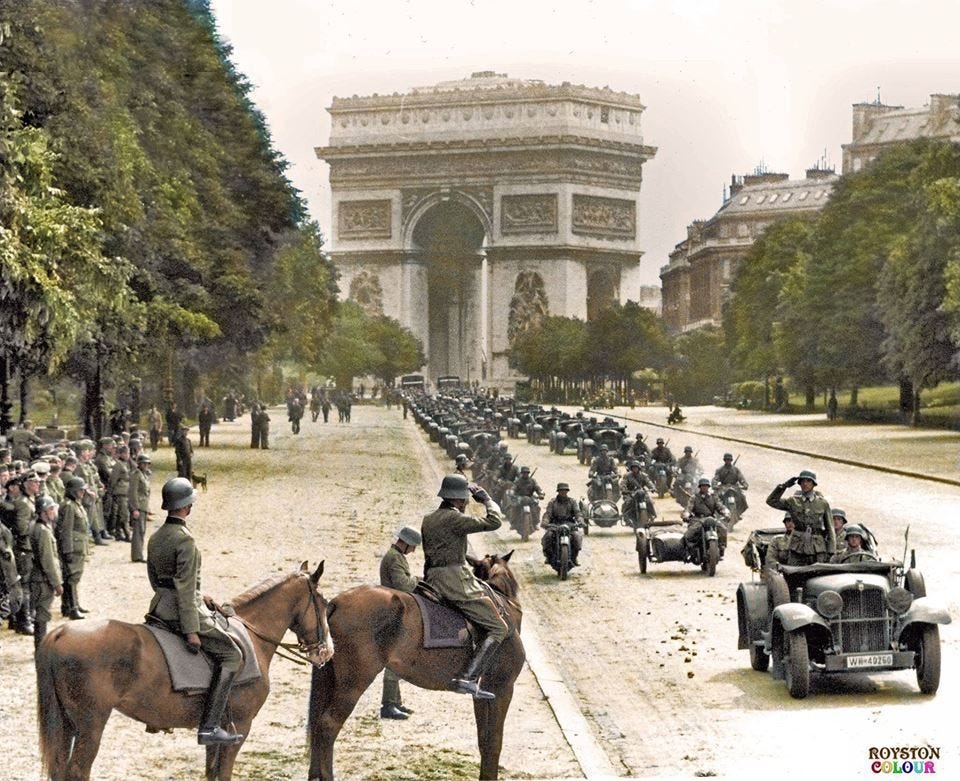
German troops parade beneath the Arc de Triomphe, June 1940.
The missing arsenal.
This outcome was not inevitable. France had plenty of time to prepare. Germany brought back conscription in 1935 and unveiled a secret air force. The next year it marched into the Rhineland. Göring’s Four-Year Plan explicitly put the economy on a war footing. And Paris did respond. Its spending on armaments rose more than tenfold in cash terms between 1935 and 1939. The 1936 rearmament programme alone was the largest in the Republic’s history.15
Despite this gargantuan effort, the weapons did not arrive. The first delivery of the 47mm anti-tank gun – the weapon that could stop a German tank at range – was supposed to come in February 1938. It arrived in November, and at first only five a month were made. Aircraft production was the worst of all. In 1938, Germany was building nearly four times as many military aircraft as France.16
French factories were not producing as much because French workers were not working as much.17 This can be traced back to a law, passed in June 1936, that cut the working week to forty hours.
The country had a limited supply of skilled labour. The men who could work the factories took years to train, and there were none left to hire. When these workers work fewer hours, output falls.
Happich, the engineer who had run the army’s arms factories, told the postwar parliamentary inquiry that, after the law was passed, ‘the rate of production halved. Which is extraordinary, because going from 48 hours to 40 ought to cost you a sixth, not a half.’18
Why France stopped working.
It was not, as the stereotypes go, because the French didn’t like to work. To understand how a country backs itself into a corner like this, you have to go back to the Depression, which hit France in a peculiar and cruel way.
France got through the 1920s by devaluing. In 1928, the prime minister Raymond Poincaré fixed the franc at a fifth of its pre-war gold value. This made French goods cheap abroad, which led to a boom in the economy and allowed France to sit out the first two years of the Depression. When you are under a gold standard, your currency’s value is fixed by law. This became a problem for the French when other countries let their currencies fall. Britain left gold in 1931, Germany imposed exchange controls the same year, and the United States left gold in 1933 – and, as a result, their exports became cheaper in every market where they competed with French ones.
The French establishment resisted leaving gold. The franc had collapsed in recent memory and wiped out a generation of savings. Besides, France had the largest gold reserves in Europe, and many on the right saw a strong currency as a matter of national honour. So they held on. French exporters lost their customers, and French firms at home lost sales to cheaper imports. As a result, prices had to fall; wholesale prices fell by 36 per cent between 1930 and 1935.19
Deflation of this kind is brutal. Wages are hard to cut, so employers cut hours and jobs instead. Debts are fixed in francs, so falls in prices make paying them back harder. Cutting government spending – as Pierre Laval did when he issued the décrets-lois de misère – removes demand from an economy already short of it. When France finally devalued in September 1936, it could have been the start of a recovery, but by then the damage had already been done.
France was stagnating. According to modern definitions, fifteen per cent of the industrial workforce was unemployed in 1935. The reality was even worse. Over half a million French women left the workforce between 1931 and 1936 and almost 400,000 immigrant workers left. None of them appear in the fifteen per cent figure. More importantly, most French factories did not lay people off. They cut hours instead. By February 1935, 45 per cent of the workforce covered by the Ministry of Labour’s surveys was on short time.20
The politics of unemployment could not hold. In 1936, two million workers went on strike. When the Popular Front – an alliance of Socialists, Communists and Radicals under Léon Blum – took office, its first act was to summon the employers’ federation and the trade unions to the Hôtel Matignon and settle it.
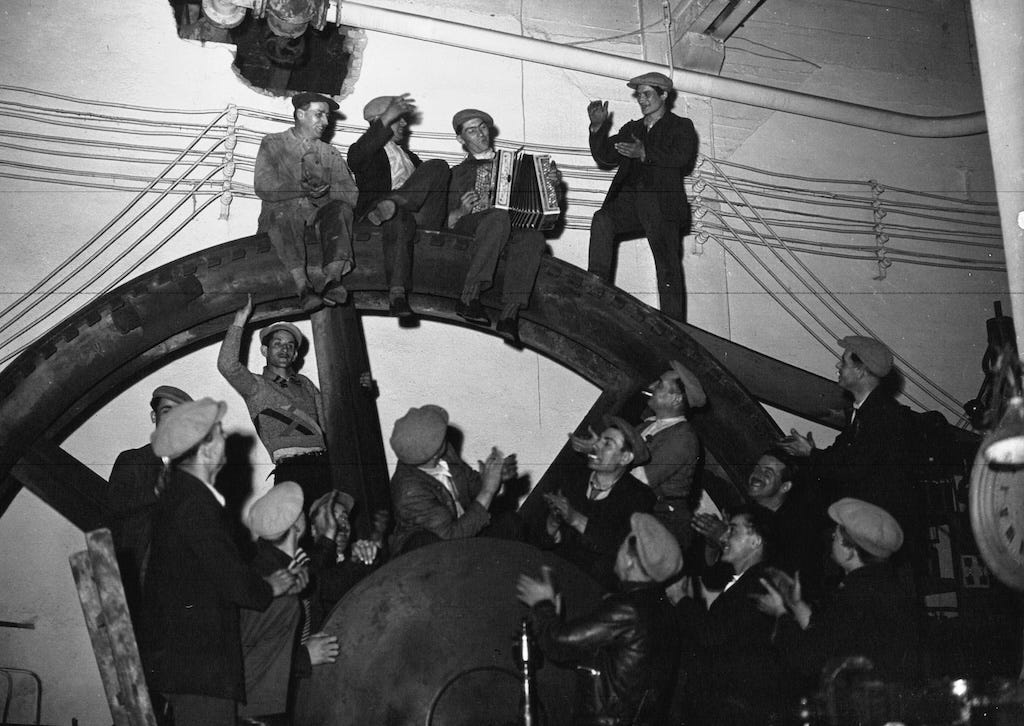
Strikers perform music in an occupied factory (1936)
The Matignon agreements of the 7th of June gave the strikers what they wanted, and then the Chamber gave them more. Wages went up by twelve per cent on average. Employers were forced to recognise unions, negotiate collective agreements sector by sector and accept elected shop-floor delegates. The Chamber passed a law that cut the working week from forty-eight hours to forty, with no cut in pay. A week’s wages now bought forty hours of work instead of forty-eight. Together with the pay rise, the cost of an hour of labour rose by about a third – and this in an economy whose prices had just fallen by more than a third.21
But what really did damage was the limit on the hours. Forty hours was a ceiling, which meant that a factory could not run forty-four hours one week when demand was higher and thirty-six the next when it was lower. It also was not allowed to stagger its shifts to keep the factory running longer. Timetables had to be filed with the labour inspector in advance so schedules could not be adjusted after the fact, and any time lost to a strike could not be made up afterwards.
A firm could apply for overtime if it proved it could not find more workers to hire. But the local delegates rarely accepted this: there were men out of work, after all, and it was not their concern that these men were labourers without the requisite skills. In the rare cases where an application succeeded, overtime was limited to an hour a day and seventy-five hours a year and in practice needed the union’s consent, which in the Parisian armaments plants was almost never given. Work for national defence could be exempted by government order, but until the general strike of November 1938 failed, one witness told the inquiry, that exemption was ‘entirely theoretical.’ At Puteaux, the state arsenal that made France’s guns, piece-rate bonuses were capped at a fifth of wages by the unions, so the best men had to slow to the average pace, according to a 1941 report by an arsenal engineer.
The idea, widely held on the left across Europe, was that these restrictions would spread the available work across more people. If each person worked fewer hours, there would be more men in work. This was wrong in two ways. Work is not fixed: an economy where things cost a third more to make produces less. Even if the total amount of work available had held, the factories needed skilled work. The problem was that the men out of work were labourers from the industries that suffered the most from the Depression, like the building trades and textile mills. These men did not have the skills to work in the factories and retraining them would take years. As a result, overall employment in French industry barely moved after the law was passed, but output fell.
Britain also suffered from the Depression and had its own angry unions, but there the standard week was kept at forty-seven hours and men routinely worked more. Instead of a legal cap on hours, the unions were given higher wages and paid overtime. This meant that when war came Britain could increase output, whereas France would have to fight a massive political battle.
French hours only began to rise in the spring of 1939, after the decrees let defence plants work up to sixty hours a week and set a forty-five-hour week everywhere else, with hours forty-one to forty-five paid at the ordinary rate. By July, metalworkers averaged forty-four hours: still six short of where British engineers had been all through peacetime, and sixteen short of where they would be in 1940.
The counterfactual.
What would have happened, hypothetically, if the law had not been passed? Let’s suppose France had worked British hours. What would French factories have produced?22
Most of the effect is intuitive: if you work less, you produce less. But there are other factors we need to consider. Factories get faster the more they build – in American aircraft production during the war, a doubling of cumulative output cut the labour needed per unit by roughly a fifth. Cheaper labour also leaves more of a fixed budget for machines, which one would expect to further raise output. The third factor is disruption: new rules and actors like shop-floor delegates slow the pace of work. But you also need to consider fatigue: productivity falls after the 49th hour.
Applying these estimates, France would have produced the following:
What would this have meant for the battle? In this world, the Allies meet the Panzers with almost as many armoured divisions as Germany and four-fifths as many tanks inside them. They have more modern fighters than the Luftwaffe and the infantry along the Meuse have more anti-tank guns to stop the tanks.
Pretty good, right? Well, this probably still understates the case because faster production means more time to train. In this scenario, the divisions could have been formed in 1938, not January 1940. And two years of exercises teach you more than four months. Maybe in that time they would have realised that radios in tanks are helpful, that armour needs motorised infantry beside it, and how to keep it fuelled in battle.
More tanks also might have convinced them to concentrate their forces instead of dispersing two-thirds to the infantry – which is precisely the technique that so advantaged the Germans. Finally, more aircraft would have allowed France to hit the hundred-and-fifty-mile traffic jam in the Ardennes, instead of keeping half of them tucked away in case the war lasted longer.23
You have objections? Fine, let’s go through some:
‘France had enough tanks, it just used them badly.’ True, and we should assume it uses them just as badly in the counterfactual. But even if France still put two-thirds of its tanks in the infantry, the remaining third would have been nearly enough to match the Panzer divisions.
‘The Allies would still have marched into Belgium and been cut off.’ Most likely. But an army with more divisions keeps a bigger reserve and that would have provided much-needed reinforcement on the Meuse. A larger air force would also have been able to shift targets from Belgium to the Ardennes in an afternoon and attack the vulnerable traffic jam.
‘If the money had bought more, governments would have spent less.’ Not impossible. But the Allies were not spending to a target. They expected a long war and were spending as much as they could without wrecking their exports and credit.
‘French doctrine was bad in a dozen other ways.’ Yes, a slow, artillery-led battle with tanks spread among the infantry was not the right strategy in 1940. But better doctrine gets you more from the same weapons and more weapons get you more from the same doctrine. More guns covereth a multitude of sins.
More speculatively, the period between 1937 and 1940 might have looked very different had France produced at the same rate as it had prior to the law being passed. Would there have been a Munich? Perhaps not. Édouard Daladier, who was prime minister at the time, went in believing France could not win a war. And Hitler needed Czechoslovakia: looting its central bank was vital to keep the economy afloat until the war began.24
Even if Germany had still taken Czechoslovakia, a delay would have favoured the Allies, and Hitler knew it. In November 1937, he told his commanders that Germany’s armaments lead was temporary, and he was right. Once the British and French rearmament programmes began to catch up, the clock was ticking.
The long shadow of bad policy.
When Blum brought the employers and the unions to the Hôtel Matignon, nobody imagined they were deciding whether France would remain a sovereign state, or that they would leave Britain fighting alone for the survival of the free world. They were solving a domestic problem and the compromises they made were defensible at the time.
Nor could they have imagined what would become of them. Half of the CGT’s Matignon delegation ended up working for Vichy. One of them, René Belin, signed the very decree that dissolved the union he had helped run. Those who didn’t fared worse. Of the 25 federation leaders we could trace, ten served the regime; of the fifteen who did not, most were imprisoned or shot.25
Was a different path possible? Something probably had to be given to the strikers. But the forty-hour week was not what the men occupying the factories were fighting for. Their primary demands were pay, collective contracts and recognition; the hours cap came from the Popular Front’s programme, which presented the policy as a cure for unemployment. Similarly, the deflation that made the strikes so bitter was a choice. Britain, which left gold in 1931, was growing again by 1933, which meant labour’s demands could be met with wages and overtime.
What struck us as interesting is how persistent countries’ problems are. Policies are sticky. Even though the forty-hour week did not exist under Vichy, the French quickly restored it after the Liberation, and spent the next sixty years further shortening it. Today, the French work fewer hours per head than citizens of any other OECD country. Britain has its own version of this: much of its political economy has been held hostage by the 1947 Town and Country Planning Act.
Bad laws don’t just persist; they compound. Bryan Caplan’s idea trap describes a cycle where bad policies produce bad outcomes, which make people angrier and more receptive to even worse ideas: ‘Depression and disarray benefit the Lenins of the world.’
Passing good policy therefore becomes doubly important: you are not only solving today’s problem but also setting the terms on which every later problem is solved. This is a good reminder for those who want to pass expedient policies for political gain with the justification that the damage can be undone later. Sometimes it can’t! The miasma of a bad law thickens with age.
Which brings us back to those who ask us for ‘AI policy’. The countries that come out of this inflection point ahead will be the ones with good policies writ large: places that have functioning incentive systems, strong institutions and the means to defend themselves and their beliefs. We should be humble enough to remember the lesson of the Battle of France as we legislate for AI – and be ready to look in unlikely places for the reforms that will let us share in its benefits.
Note: AI helped us find sources, translate French archival material, check facts and build the appendix. We have tried to verify every claim against the original; where we’ve fallen short, we’d be grateful to hear about it.
Mark Harrison, “The Economics of World War II: An Overview”, in Harrison (ed.), The Economics of World War II (Cambridge University Press, 1998). GDP from Table 1-3, in 1990 international dollars, for 1939: Britain $287bn, France $199bn; Germany $384bn, Austria $27bn. Territory from Table 1-1: Britain, France, the Dominions and the two colonial empires covered 47.1 million km² in 1938, against a world land surface of roughly 149 million km².
Authors’ calculation of military spending 1933–39 at purchasing-power parity. Military shares of national income from Robert Frankenstein, “Intervention étatique et réarmement en France 1935–1939”, Revue économique 31:4 (1980), pp. 743–81, Tableau 1 [https://www.persee.fr/doc/reco_0035-2764_1980_num_31_4_408550]; the German figure includes off-budget Mefo financing, from Adam Tooze, The Wages of Destruction: The Making and Breaking of the Nazi Economy (Allen Lane, 2006) and Richard Overy, War and Economy in the Third Reich (Clarendon Press, 1994). Figures for the Dominions, Belgium and the Netherlands from Correlates of War. GDP from Harrison (1998), Table 1-3. Germany’s lead over Britain and France alone is under 25%; including the Dominions and the Low Countries, under 15%. Method in the appendix.
Annualised rates at the turn of 1940. Britain: £29.6m a week in December 1939 (Hancock and Gowing, British War Economy, p. 348), or £1.54bn a year. France: a military budget of 55bn francs a quarter (Philip 1940), or £1.25bn at 176 F/£. Dominions: roughly £0.1bn. Germany: 12bn RM in the war’s first four months (Overy 1988), or £2.23bn at a purchasing-power rate of 16.1 RM/£. Allied total £2.89bn, a ratio of 1.3:1. At the official rate of roughly 10 RM/£, the ratio is 0.8:1.
Naval spending: authors’ calculation from Jost Dülffer, Weimar, Hitler und die Marine: Reichspolitik und Flottenbau 1920–1939 (Droste, 1973) and the Navy Estimates 1933–40, converted at RM 12.2 to the pound. Tonnage launched or on the stocks, 1933–39, by standard displacement from Robert Gardiner (ed.), Conway’s All the World’s Fighting Ships 1922–1946 (Conway Maritime Press, 1980): about 870,000 tons for Britain against 500,000 for Germany. Method in the appendix.
The 1st and 2nd Divisions cuirassées were formed on 16 January 1940, the 3rd on 20 March, the 4th on 15 May; the first three Panzer divisions on 15 October 1935. Robert A. Doughty, The Breaking Point: Sedan and the Fall of France, 1940 (Archon, 1990), ch. 1; Karl-Heinz Frieser, The Blitzkrieg Legend: The 1940 Campaign in the West (Naval Institute Press, 2005), ch. 1.
The Renault R35, the most numerous French tank, was built without radios apart from a single battalion; the Hotchkiss H35 and H39 likewise. Of the Somua S35s, only the platoon commander’s tank carried a set, so four in five had none. Only the Char B1 bis carried a radio in every tank and it was mostly a Morse set. Pascal Danjou, Somua S35 (Trackstory 1, 2003); Steven Zaloga, French Tanks of World War II (1) (Osprey, 2014); François Vauvillier’s series in GBM. Every modern tank of German manufacture, by contrast, had at least a receiver.
Ingénieur en chef Lefranc, formerly head of the artillery matériel section of the Direction des Fabrications d’Armement, note on anti-tank matériel, in Rapport fait au nom de la Commission chargée d’enquêter sur les événements survenus en France de 1933 à 1945 (Assemblée nationale, 1947–51; hereafter Serre, with tome number), Annexes, pp. 201–212 [https://gallica.bnf.fr/ark:/12148/bpt6k6531459j/f225.item]: the 47mm was expected in February 1938 and left the factory from November, “at first at a very low rate: 5, then 10, then 20 a month”. Lefranc’s note was written in 1941, during the Riom proceedings, and reads as a brief against the 1936 laws. We cite it only where the engineers who testified to the commission in 1949, Happich and Martignon, say the same. Translations from the French are ours; links go to the page scans on Gallica.
Joseph Paul-Boncour, hearing of 9 March 1948, Serre, T3, p. 803 (https://gallica.bnf.fr/ark:/12148/bpt6k65369911/f251.item), recalling the meeting of the Comité permanent de la défense nationale on Czechoslovakia in March 1938, where this was Pétain’s only remark. A recollection a decade after the event, by a witness with no sympathy for Pétain.
Frieser (2005), ch. 2, for the postponements and the Mechelen incident of 10 January 1940; ch. 4 for the Ardennes columns.
The 55e Division d’infanterie was a series B reserve division of older reservists. On its shortage of anti-tank guns and the panic on the evening of 13 May: Doughty (1990), chs. 3, 5 and 6.
Denis Richards, Royal Air Force 1939–1945, vol. 1: The Fight at Odds (HMSO, 1953), ch. 5, for the Advanced Air Striking Force’s attack on the Sedan bridges on 14 May: 71 aircraft dispatched, 40 lost. The War Cabinet’s decision of 19 May to send no further fighter squadrons to France, after Dowding’s letter of 16 May: Julian Jackson, The Fall of France (Oxford, 2003), ch. 2.
The 3e Division cuirassée, formed on 20 March 1940, at Stonne; the 1re DCR, formed 16 January, caught refuelling at Flavion on 15 May by the 5th and 7th Panzer Divisions: Frieser (2005), ch. 5; Doughty (1990), ch. 8; and General Georges’ account, Serre, T3, p. 693.
After the encirclement of the northern armies the Allies had lost roughly 44 per cent of their divisions; on the Somme and Aisne on 5 June the German advantage was about 1.9 to 1. Authors’ count from Frieser (2005), ch. 9; appendix.
Authors’ calculations. French payments to Germany as a share of French GDP from Filippo Occhino, Kim Oosterlinck and Eugene N. White, “How Occupied France Financed Its Own Exploitation in World War II”, NBER Working Paper 12137 (2006), Table 1, published as “How Much Can a Victor Force the Vanquished to Pay? France under the Nazi Boot”, Journal of Economic History 68:1 (2008). Italian military spending and all GDP figures from Harrison (1998), Tables 1-1 to 1-3 and 1-8. Method in the appendix.
Armaments expenditure rose from 4.4bn francs in 1935 to 46.7bn in 1939: Philippe Garraud, “La politique française de réarmement de 1936 à 1940”, Guerres mondiales et conflits contemporains 219 (2005), citing Crémieux-Brilhac. The 14bn-franc programme of 7 September 1936: Robert Frankenstein, Le prix du réarmement français, 1935–1939 (Publications de la Sorbonne, 1982).
Richard Overy, The Air War 1939–1945 (Europa, 1980), Table 2: 5,235 German and 1,382 French military aircraft in 1938.
The weight given to the forty-hour week is disputed. Frankenstein (1982); Jean-Charles Asselain, “Une erreur de politique économique: la loi de quarante heures de 1936”, Revue économique 25:4 (1974); Alfred Sauvy, Histoire économique de la France entre les deux guerres, vol. 2 (Economica, 1984), pp. 377, 405; and Herrick Chapman, State Capitalism and Working-Class Radicalism in the French Aircraft Industry (1991) treat it as central. Garraud (2005) and Talbot Imlay, Facing the Second World War (2003) stress the disorganisation of rearmament, the lack of industrial relations coordination and the late placing of orders, as did the CGT at the time. Our estimate of the size of the effect, and how it was made, is in the appendix.
Ingénieur général Happich, hearing of 2 June 1949, Serre, T6, p. 1730. Happich had run the army’s arms manufactures (Direction des Fabrications d’Armement) from January 1936 to April 1939; his figure is for light and heavy tanks together, and he gave it as approximate.
Registered unemployment was about 4 per cent of wage earners; the industrial rate of 14.5 per cent for 1935 is Galenson and Zellner’s estimate, in Barry Eichengreen and T. J. Hatton (eds), Interwar Unemployment in International Perspective (Kluwer, 1988), Table 1.1. Women and foreign workers, from the 1931 and 1936 censuses: Sauvy (1984), pp. 35–37 [and page for foreign workers]. Short time: Gary S. Cross, Immigrant Workers in Industrial France: The Making of a New Laboring Class (Temple University Press, 1983), ch. 9, n. 79; the Ministry of Labour’s surveys covered establishments of 100 or more workers.
Unemployment from Eichengreen and Hatton (eds), Interwar Unemployment in International Perspective (1988), ch.1. The census count of the unemployed, nearly double the relief figure in March 1936, the fall in the active population between the 1931 and 1936 censuses, and the withdrawal of women from the labour force are Alfred Sauvy’s: Sauvy (1984), pp. 24, 27–28, 35–37. Short-time figures from Cross (1983), Immigrant Workers in Industrial France: The Making of a New Laboring Class, Chapter IX, note 79. The Ministry of Labour’s surveys only covered establishments larger than 100 people.
The Ministry of Labour counted 1,831,000 strikers in June 1936: Julian Jackson, The Popular Front in France: Defending Democracy, 1934–38 (Cambridge, 1988), ch. 4, which also gives the Matignon terms. A 12 per cent rise on a week’s pay now buying 40 hours instead of 48 is 1.12 × 48/40 = 1.34.
Method, sources and spreadsheet in the appendix. The multipliers are applied only to lines where production was capacity-bound; where the sources show plant idle for want of orders, only the cost saving is booked.
1,487 of France’s 2,489 modern tanks with a gun on the north-east front were in independent battalions attached to infantry, from Vauvillier’s tallies; of 2,005 modern fighters, 946 were with the armies, 909 in the interior (628 unassigned at the Châteaudun depot) and 150 overseas (Buffotot and Ogier 1975).
Tooze (2006), ch. 9, on Austrian and Czech gold and foreign exchange and the balance-of-payments crisis of 1938–39.
Authors’ count of 35 CGT leaders in 1936 (the six Matignon signatories, the eight-member confederal bureau, and the general secretaries of 25 national federations, each person counted once), drawn from their notices in the Maitron. 12 worked for Vichy (34%), 10 were imprisoned (29%), 2 were shot (6%), 1 was a prisoner of war and 10 were free. “Imprisoned” includes internment by the Third Republic from September 1939, by Vichy and by the Germans.